Real Estate Software
All-in-one real estate software for developers, owners, and operators.
Run development, leasing, and accounting on one platform built on Acumatica. Cut month-end close time in half. Trusted by 1000s of real estate firms.
Used by Controllers, CFOs & Operators at 1000s of firms
New Book
Stop managing projects through the rearview mirror.
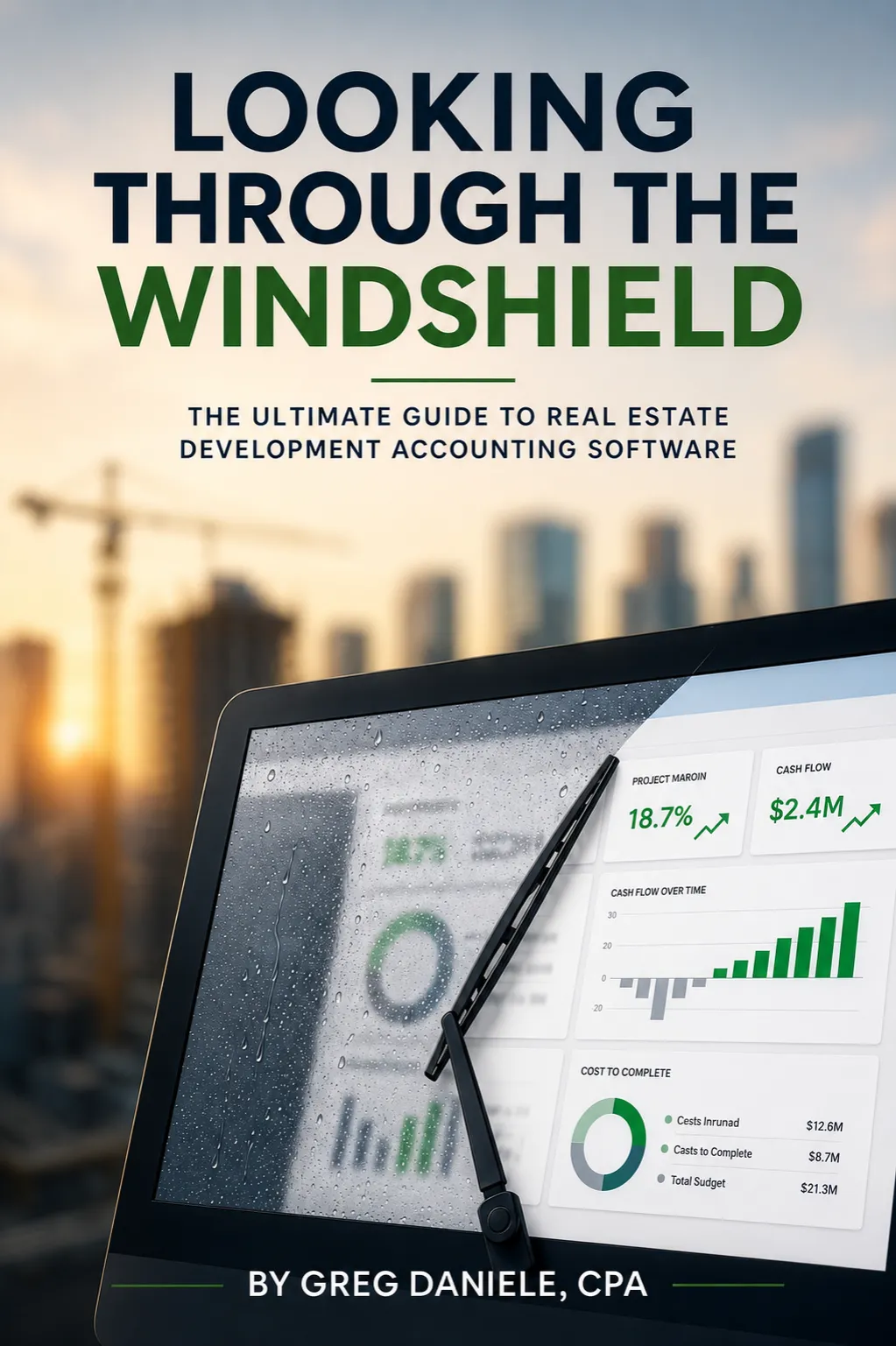
Looking Through the Windshield — the ultimate guide to real estate development accounting software. By Greg Daniele, CPA.

Acumatica gold certified partner
Real Estate SoftwareThat Works Like You Do. Only Better.
Imagine a single commercial property management software platform to develop and manage the end-to-end daily operations of all your real estate assets. Our all-in-one solution empowers enables real estate professionals to effectively manage development, leasing, tenant satisfaction, maintenance, accounting, and financial reporting throughout the lifecycle of any real estate asset.
Real Estate Development
Software
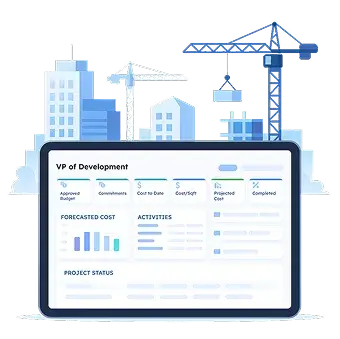
Complete more projects on time and on budget. Automated Loan draws, real-time budgets, complete project history, and forecasting from pre-development to profitable completion.
Land
Development
Software
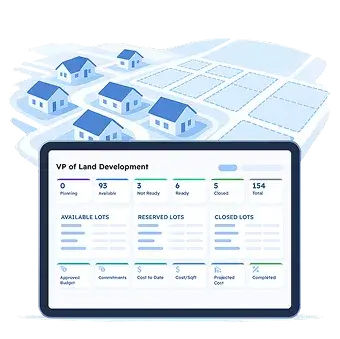
Sell every lot with full inventory and takedown control. Builder agreements, demand forecasting, and profitability in one view.
Commercial
Property Management
Software
Lease faster, bill smarter, retain tenants longer. Automated CAM reconciliation and NOI dashboards.
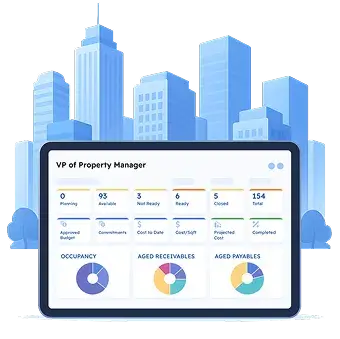
Stop managing commitments in spreadsheets. Start seeing the full picture.
Track contracts, change orders, and direct costs in real time, so you always know what you're obligated to pay, not just what you've been invoiced.
One source of truth for every project, every entity, every dollar.
Real-time budget-vs-actual visibility across your entire portfolio with automated draw packages that go from six hours of assembly to thirty minutes.
Complete cost control, from the first land payment to final closeout.
Track budgets by cost code, capture every commitment before the invoice arrives, and surface cost overruns while you can still act.
Manage every lot from acquisition
to sale.
Specialized inventory tracking built for land developers lets you monitor lot status, phase progress, and builder assignments from a single platform.
Commit to takedowns, manage builder agreements, and forecast demand with precision.
Track builder obligations and lot absorption so you always know what's committed, what's sold, and what's coming.
Complete visibility into lot status, sales pipeline, and profitability.
See every lot’s financial status and profitability in real time backed by the full power of development accounting, cost control, commitment management and cost-to-complete forecasting.
Reduce lease administration burden and increase NOI.
Automated workflows handle everything from lease tables to expense recovery, so your team spends less time on admin and more time managing the portfolio.
Streamline CAM reconciliations, automate rent escalations, and give tenants self-service access.
Branded tenant portals and automated billing workflows eliminate manual processes and reduce the back-and-forth that slows your team down.
Manage your entire portfolio from one centralized platform.
Real-time financial reporting and compliance tracking across every property: no silos, no spreadsheets, no month-end surprises.
Trusted by Real Estate Professionals
“We have visibility across our entire portfolio now. Draw requests that used to take days are down to almost an hour.”
CFO,
Real Estate Development Firm
“We used to hunt for answers. Now they’re just there. Real-time lot tracking and cost control mean we see issues coming before they become problems.”
VP of Finance,
Land Development Company
“We consolidated three systems into one and cut our month-end close time in half. Everything’s in one place: property management, CAM recovery and tenant improvements. It’s been a game changer for our operations.”
Controller,
Property Management Company
1000+
real estate firms
100%
Acumatica-native
8-12wks
typical implementation
Unlimited
users — no per-seat fees
You Need More Than Software.
You Need Control.
Get it from real estate software professionals who’ve been helping companies like yours succeed.
OPEN ARCHITECTURE
Built on Acumatica, not a closed system.
Your data is yours. No vendor lock-in.
Integrates with any tool in your modern
stack — banks, payment processors, BI tools.
REAL ESTATE DNA
Real estate-specific, not a generic ERP bolt-on.
40 years of CPA experience baked into every
workflow — draws, CAM, takedowns, lot
tracking. Built for how real estate actually
works.
HONEST PRICING
Predictable Pricing.
Unlimited Users.
No per-seat fees. No surprise upgrades. Add
properties, projects, and team members
without adding cost.
Get Started in Three Steps
Discovery Call - 20 minutes
Share your goals and current pain points: development cost tracking, loan draw management, property operations, or portfolio expansion. We'll map your needs to solutions.
Custom Demo — within 5 business days
See a personalised demo of features that match your challenges. Real-time budget management, automated draw management, streamlined CAM recovery, and portfolio analytics — built around your workflow.
Live in 90 days — onboarding without disruption
Our team handles all aspects: data migration, system configuration, integrations, and training. Real estate professionals guide you every step.
No sales pitch. No pressure. If we're not a fit, we'll tell you on the first call.
Frequently Asked Questions
Everything you need to know about our real estate development software
How much does Elevate Solutions cost?
Pricing starts at $X per month and depends on your portfolio size, modules selected, and implementation scope. Unlimited users included on every plan. Book a discovery call for a custom quote.
How does Elevate compare to Yardi, MRI, or AppFolio?
Unlike per-seat ERPs, Elevate offers unlimited users, an Acumatica-native open architecture, and real-estate-specific workflows out of the box. [Full comparison guide coming soon].
Is my data secure? Where is it hosted?
All data is hosted on Acumatica’s SOC 2-compliant cloud infrastructure with daily backups, encryption at rest and in transit, and role-based access controls.
Can I migrate from QuickBooks, Sage, or Yardi?
Yes. Our team has migrated clients from QuickBooks, Sage Intacct, Yardi, MRI, and several legacy systems. Typical migration takes 6-12 weeks as part of standard implementation.
How long does implementation take?
Most clients are live in 6-12 weeks. Smaller portfolios with simpler requirements can be live in 4-6 weeks; larger multi-entity deployments take 12-16 weeks.
What is real estate development software?
Real estate development software is a purpose-built financial platform designed for the complexity of property and development businesses, not retrofitted from a general accounting tool.
Standard accounting packages were built for predictable revenue and one set of books. Real estate doesn’t work that way. You’re managing multiple entities, tracking costs across dozens of cost codes, processing construction draws, handling lease management, and producing project-level financials, all at once.
Real estate accounting software like Acumatica handles all of that natively. Multi-entity management, project accounting, commercial property management, and real-time reporting in one integrated platform, so your CFO, project managers, and asset managers are all working from the same numbers.
Why is Excel inefficient and risky for real estate development and property management?
Excel is powerful, but it was never designed to be your real estate development software. And when you try to use it that way, the cracks show fast.
The moment you export data from your accounting system into a spreadsheet, it’s already stale. Every invoice posted, every change order approved after that export, none of it is in your model. Your team is making decisions on yesterday’s numbers while treating them as current.
There’s also key-person risk. One person understands the consolidation model. One person manages the draw package process. When they leave, you don’t just lose an employee, you lose the system holding everything together.
Two projects, Excel works. Five, it strains. Ten, it breaks. The administrative burden doesn’t add as you grow, it compounds. That’s not a workflow problem you can optimize around. It’s a structural one.
Why isn't QuickBooks a great solution when you start to scale?
QuickBooks is fine for what it was designed to do. Real estate development accounting isn’t it.
When a vendor invoice covers multiple projects, you enter it five times, once per company file. When consolidated financials are due, you build an Excel model manually. When a lender asks for portfolio performance, the honest answer is: “Give us a few days.”
The entity-switching alone, logging out, logging in, logging out, costs your team hours every week. Monthly consolidated statements require two to three days of controller time because consolidation lives entirely outside the system. For a five-entity portfolio, that workaround approach runs roughly 500 hours of unnecessary manual work per year.
That’s not inefficiency. That’s a tax on your growth. Commercial real estate property management and development organizations need a platform built for multi-entity complexity, not a workaround bolted onto single-entity software.
Why is multi-entity functionality critical in real estate development software?
Because every smart developer structures their portfolio around separate LLCs, and if your accounting system doesn’t understand that, you’re constantly fighting your own infrastructure.
Most accounting platforms were built for one set of books. When you force them to handle twenty entities, you’re not using a feature, you’re building a workaround. And workarounds collapse as your portfolio grows.
Multi-entity functionality built into the DNA of your real estate asset management software means shared expenses allocate automatically, intercompany balances reconcile without Excel, and consolidated financials take minutes, not days. When your lender calls asking for portfolio-level reporting, you deliver it in real time instead of asking for the weekend.
That architectural difference is what separates platforms like Acumatica from tools your commercial real estate management software simply wasn’t designed to handle.
Why should I switch from my current system?
You don’t have to switch until staying hurts more than changing. For most real estate development and commercial property management companies, that moment comes earlier than expected.
Legacy tools, disconnected accounting packages, spreadsheet consolidations, siloed project management software, were built for a different pace of business. They can’t keep up with a growing portfolio.
Migrating to Acumatica commercial property management software gives you: real-time project financials without waiting for month-end close, centralized control across your entire asset management lifecycle, and a platform that eliminates the manual work costing your team hundreds of hours a year.
You also get resilience. Visibility from frontline operations to bottom-line results. A built-in CRM that eliminates silos. And a system that scales with you, not one you scale around.
What features should I look for in the best real estate development software?
Look for software built for real estate development, not adapted to it as an afterthought.
The best real estate development software handles construction management natively: budget tracking by cost code, change order management, lender draw packages, and contract reconciliation, without requiring a parallel system to hold it together. It should support the full development lifecycle, from land acquisition through construction, lease-up, and stabilized operations.
For commercial property management, you need lease management built in: rent escalations, CAM reconciliations, and tenant billing without a separate platform. For your finance team, look for real-time dashboards, project-level accounting, and multi-entity reporting that doesn’t require an Excel model to produce.
Cloud-based access matters too. Construction doesn’t happen at a desk. Your real estate development platform shouldn’t require one.
Why should project managers choose real estate development software for managing a new property or expanding a portfolio?
Because fragmented tools don’t scale, and project managers are always the first to feel it.
When accounting can’t produce budget reconciliations in real time, project managers wait. When change orders live in one system and invoices in another, they become data managers instead of project managers. That’s not what you hired them to do.
Real estate development software solves this by centralizing budgets, contracts, change orders, timelines, and financial reporting in one platform. Project managers get real-time visibility into budget versus actuals. Corporate occupiers can model scenarios and report to investors without rebuilding an Excel model for every stakeholder.
The right real estate development management software also creates consistency across your portfolio. Instead of rebuilding your systems with every new project, you’re scaling infrastructure designed to grow with you.
Why is real estate software essential for managing property development and investment?
Real estate investment is a long game. Decisions made at the front end, land pricing, development budgets, capital structure, have consequences that take years to surface. That makes data quality and financial visibility more important here than in almost any other industry.
Real estate development software solutions centralize financial data, legal documents, project timelines, investor reporting, and lender compliance in one secure platform. That eliminates the information silos that slow decisions and create risk. When your CFO, project manager, and asset manager work from the same data, you move faster and make better calls.
For real estate investment specifically, the ability to track performance against underwriting assumptions and produce investor-grade reporting in real time is a competitive advantage. Organizations that demonstrate operational discipline, clean financials, real-time visibility, attract better capital on better terms.
Companies that catch cost overruns and schedule delays early aren’t lucky. They have the right infrastructure.
What is Acumatica, and why does Elevate Solutions implement it?
Acumatica is one of the world’s fastest-growing ERP platforms, built for small to mid-sized businesses that need enterprise capability without enterprise complexity. Fully cloud-based, consistently rated highest in customer satisfaction in its category, and built on an unlimited-user licensing model, meaning your whole team accesses it without being penalized for growth.
For real estate, Acumatica isn’t a general ERP that happens to work in the industry. It supports commercial property management software, real estate development accounting, construction management software, fixed asset management, project accounting, and CRM, all in one integrated system.
Elevate Solutions recommends Acumatica because we’ve evaluated the landscape, worked through countless implementations across development companies and commercial property managers, and seen what other platforms can and can’t do. Acumatica consistently delivers the multi-entity capability, real-time reporting, and flexibility that real estate organizations need to operate at scale.
What makes Acumatica different from other commercial real estate development software?
A few things, and they’re architectural differences, not marketing points.
Cloud-native infrastructure means real-time access from anywhere, automatic updates, no servers to manage. Built for the way a real estate team actually works: in the office, in the field, and in front of investors.
Flexible customization using industry-standard tools means you build workflows and dashboards that match your operations, not the way a vendor thinks you should operate. And because it uses standard tools, customizations don’t break when the platform updates.
The built-in CRM connects your commercial real estate management software, financial data, development tracking, and project accounting in one place. Deal pipeline, tenant relationships, investor communications, no separate system required.
And unlimited users on-plan means your project managers, accountants, executives, and asset managers all have access. No per-user fees stacking up as you grow. That’s a different philosophy, and it makes adoption across the organization significantly easier.
Why choose Elevate Solutions as your implementation partner?
We’re one of the only real estate technology firms founded by a CPA. That matters because real estate accounting is genuinely complex, and a team that hasn’t lived inside a real estate accounting department doesn’t fully understand what “done” looks like.
Multi-entity structures, construction draw management, cost code architecture, lender reporting, investor distributions, these aren’t one-time configuration decisions. They’re daily operational realities your commercial real estate software needs to support every single day.
Our team has worked through every stage of the operational challenges our clients face. We’ve seen QuickBooks stretched past its limits on twenty-entity portfolios. We’ve watched Excel consolidations collapse under growing development pipelines. We bring that context to every Acumatica implementation, from chart of accounts design to how your real estate development accounting software integrates with lender reporting.
We’re not configuring software. We’re building the operational infrastructure your real estate organization depends on. And we’ve seen enough to have a solution for everything.
How Does Acumatica Property Management Help Streamline Commercial Lease Management?
Acumatica’s all-in-one property management software features a lease-centric design that handles complex lease arrangements, automates CAM reconciliations, manages retail breakpoints, and provides real-time data visibility into lease performance through customizable dashboards.
Can Property Management Software Help Recover More Operating Expenses?
Yes! The right commercial property software automates complex CAM reconciliations, recoveries, and escalations, ensuring recoverable expenses are captured while dramatically reducing revenue leakage from manual calculations.
Does Real Estate Development Software Enable Better Maintenance Operations Through Its Reporting Features?
Our property management software provides work order tracking, preventive maintenance scheduling, vendor management, mobile inspection tools, and tenant portal integration for seamless service request management.
What Methods Does Property Management Software Use to Handle Critical Dates and Notifications?
Our property management software tracks lease expirations, renewal options, and insurance expiration dates through automated notifications and workflow triggers, ensuring important dates are never missed.
Can Commercial Property Management Software Handle Mixed-Use Properties?
Yes. Acumatica and similar robust platforms allow managers to oversee various property types in one place, including retail, industrial, Residential properties, and office buildings, all with property-specific configurations.
During Our Transition to New Property Management Software, What Kind of Implementation Support Should We Expect?
The transition to new property management software should include providers who deliver complete onboarding services, data migration support, customized setup, user training, and ongoing technical support to ensure maximum adoption.
How Does Property Management Software Help With Budgeting and Forecasting?
Advanced property management systems provide tools for annual budget creation, actual variance tracking, performance forecasting, scenario modeling, and investor stakeholder report generation.
How can commercial property managers benefit from the right software?
Commercial property managers can streamline operations, automate rental property collection, and generate detailed financial reports using the right software. By investing in commercial property management accounting software, managers can efficiently handle complex lease agreements, maintenance schedules, and budgeting for large commercial portfolios. This not only saves time but also improves accuracy and decision-making for both managers and real estate investors.
Why is commercial property management software essential for real estate investors with large commercial portfolios?
For real estate investors managing multiple assets, best real estate development software offers centralized control and visibility across all properties. It helps track income, expenses, and performance metrics, ensuring accurate reporting and compliance. With the right real estate development software, investors can make data-driven decisions to maximize returns and maintain healthy, scalable real estate investment management strategies.
See Acumatica in action
Book a discovery call in under 60 seconds. We’ll show you what it looks like to run your development and portfolio operations through the windshield, not the rearview mirror.
- 20-minute discovery call
- Tailored to your needs
- No pressure, no obligation